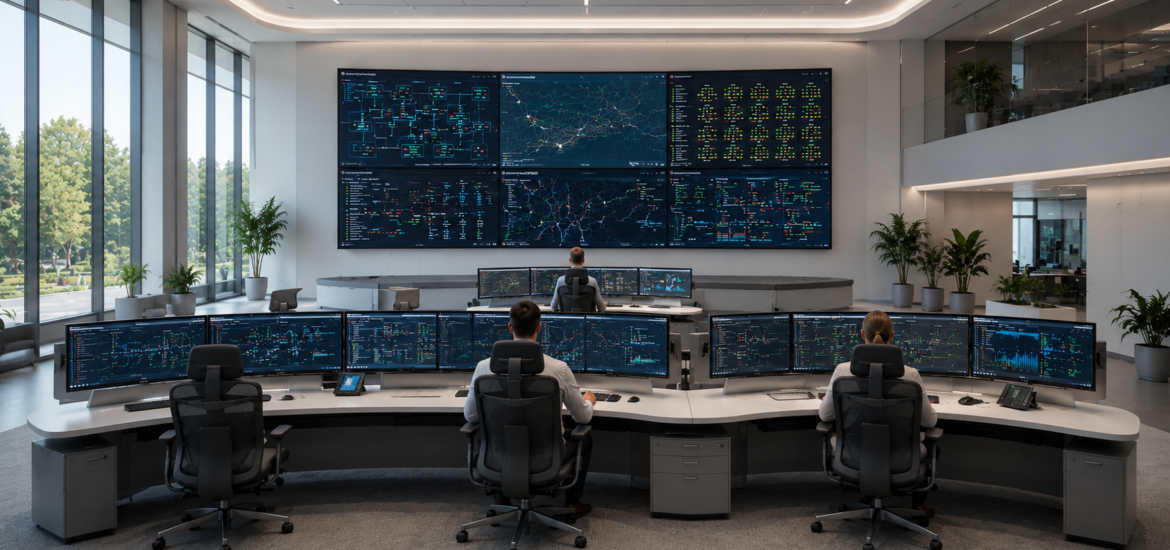
We spec the infrastructure. We test the signal chain. We make sure every source reaches every screen. And then we hand it over, to a person who’s going to sit in front of that system hour after hour, making decisions that actually matter.
How much time do we spend thinking about that part?
There is a standard for this. ISO 11064, ergonomic design of control centres. Most people outside the control room world have never heard of it. Neither had I until a few years ago.
What it comes down to is this: a bad environment doesn’t just make people uncomfortable. It affects decision quality. Cognitive load builds up over a long shift. Poor screen placement causes fatigue. Too many simultaneous alarms, alarm flooding, and the operator stops processing them properly. These have real consequences in a critical environment.
The display layer isn’t passive. What you put in front of that operator, how you position it, what quality of image they’re looking at hour after hour, that’s part of the system design. Not an afterthought.
It started with a conversation I had with Hampus Schäring at CDE, a manufacturer specialising in control room furniture. He mentioned ISO 11064 as a natural part of how they think about workstation design. Straightforward, matter of fact; this is just how we do it.
Later that day it hit me. In the AV world we have DISCAS, Display Image Size for 2D Content in Audiovisual Systems, an AVIXA standard built around viewing distance, display size and visual acuity. It even defines two levels of decision making, where the analytical level maps almost exactly to what a control room operator needs (https://www.avixa.org/resources/display-image-size-calculators/analytical-and-basic-decision-making-calculations).
Two industries. Two standards. The same problem.
Display quality in this environment is a professional requirement, not a preference. The operator is monitoring critical data hour after hour. The screen is not a peripheral, it is the interface between the operator and the process.
And it doesn’t stop at the screens. The workstation itself, the geometry, the ability to adjust and adapt; CDE has been working with this for years. Good furniture in a control room is not an aesthetic choice. It is part of the system.
We come from AV and IT. The control room world already knows what a good display looks like. What we bring is the full picture; the signal chain, the infrastructure, the integration. Not just in the control room itself, but in every space connected to it. The conference room down the hall. The break room. The security desk. It is all part of the same building.
Känner du igen de här parallellerna? Hör gärna av dig.
This is the second article in a series about what happens when AV, IT and OT converge. The first one, Has AV Left the Building? can be foud here:Has AV Left the Building?